 Tüylüm
Basenji
A small, elegant, short-coated hunting dog from Central Africa. It doesn't bark in the usual way but isn't silent either; it makes a sound all its own. Independent, intelligent and energetic; genetic screening matters because of a known kidney disease in the breed (Fanconi syndrome).

 Lifespan12+ yearsRoyal Kennel Club: "over 12 years"
 Weight21–24 lbFCI ideal: females 21, males 24 lb (9.5–11 kg)
 Height16–17 inFCI ideal: females 16, males 17 in (40–43 cm)
 OriginCentral AfricaCongo region; in Britain since 1936
 CoatShort, sleekweekly grooming (Royal Kennel Club)
 ExerciseUp to 1 hour a dayRoyal Kennel Club
 With kidsSupervisedaloof with strangers, independent
 VoiceBarklessFCI: a chortle and yodel mix
The Basenji is known as the "barkless dog," but that's a little misleading: it isn't a silent dog, it just doesn't bark. A small, elegant, short-coated hunting dog, the Basenji is, according to the FCI standard, remarkably clean in every way, independent and energetic. This page covers the breed standard, temperament, care needs and the most important health topic in the breed, Fanconi syndrome.
- Barkless, not mute: The FCI standard describes the voice as a mix of a chortle and a yodel; not silent, but no classic bark.
- Small but energetic: The Royal Kennel Club suggests up to 1 hour of exercise a day, a small house and a small or medium garden.
- Independent temperament: The FCI says intelligent, independent but affectionate and alert; it can be aloof with strangers.
- Easy grooming: The coat is short and fine; the Royal Kennel Club says weekly grooming, and the breed sheds.
- Health: Fanconi syndrome is a known inherited kidney disease in the breed; ask the breeder for the parents' DNA test results.
What to know
 What is the Basenji like?
The FCI standard describes the Basenji as "barkless but not mute": its own special noise is a mix of a chortle and a yodel. The standard also calls the breed remarkably clean in every way, intelligent, independent but affectionate and alert, and says it can be aloof with strangers.
The Royal Kennel Club's description of the hound group calls its members dignified, aloof but trustworthy companions and says many enjoy a significant amount of exercise. So the Basenji isn't a dog that runs to do whatever you ask; it makes its own decisions, and responds well to rewards and mental stimulation. Its hunting background (see below) can mean interest in small animals, which is why safe spaces matter.
"Doesn't bark" doesn't mean "makes no noise." The FCI describes the voice as a mix of a chortle and a yodel; an anxious or bored Basenji can still make enough sound for neighbors to hear. For someone who'd be bothered by a vocal dog, it's still a factor.
 Who is it a good fit for?
The Basenji can suit people who can keep a small dog busy every day, respect an independent temperament and are patient in training. The Royal Kennel Club associates the breed with a small house, a small or medium garden, and either town or country life.
| Situation | A good fit? |
|---|---|
| Apartment | Possible; the small size helps, but daily movement and mental games are a must; think about the voice and your neighbors |
| Family with children | With care; an independent dog that's aloof with strangers may not enjoy being hugged by a child |
| Other dogs and cats | Introduce calmly and under supervision; the hunting background can mean interest in small animals |
| Long stretches alone | May get destructive when bored; teach alone time gradually |
| First-time dog owners | Possible but may be hard; an independent temperament and an urge to wander call for experience |
| Noise-sensitive home | It doesn't bark but it does make noise; listen to the voice before you decide |
For help with being alone, see our post on separation anxiety in dogs.
Where does it come from?
The FCI lists Central Africa as the Basenji's origin, with the standard written under British patronage; the breed is used as a hunting dog and companion. According to the Royal Kennel Club, the breed was established in England in 1936 with imports from the Congo region, where Basenjis had been used as all-purpose hunters working by sight and by scent.
The FCI classifies the breed as a primitive type (Group 5, spitz and primitive types). In other words, the breed is classified as an older kind of dog, separate from breeds shaped by modern kennel club standards.
Appearance and colors
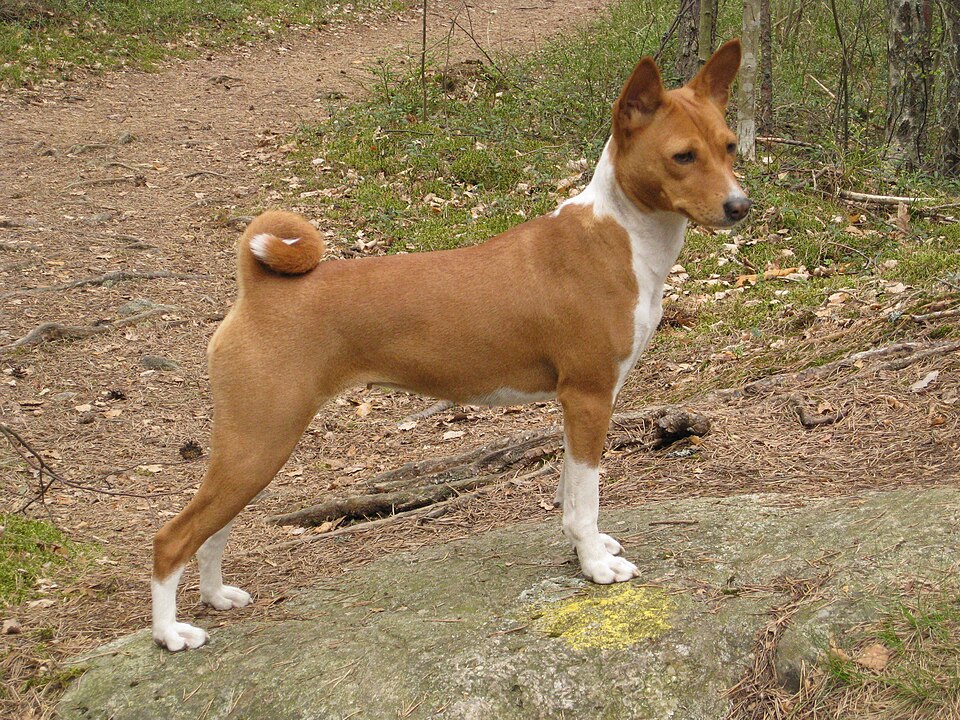
The FCI standard describes the Basenji as a lightly built, finely boned, aristocratic-looking animal, long-legged for its length, always alert, with "gazelle-like grace." The forehead has fine, profuse wrinkles, the ears are pricked and the tail curls tightly over the spine.
- Height and weight: The FCI gives an ideal of 17 in (43 cm) and 24 lb (11 kg) for males, 16 in (40 cm) and 21 lb (9.5 kg) for females.
- Coat: Short, sleek, close and very fine. The skin is very pliant.
- Color: The FCI accepts black and white, red and white, black, tan and white, tricolor, black, tan and white, and brindle (red background with black stripes). White should be on the feet, chest and tail tip.
- Head: Flat skull, slight stop, black nose preferred; eyes dark and almond-shaped.
Daily care
The Royal Kennel Club marks the Basenji's grooming as "once a week," calls the coat short and notes that the breed sheds. The standard also stresses that the breed is clean in every way.
- Brushing: A weekly brushing with a soft brush reduces loose hair and gives you a chance to check the skin.
- Bathing: Frequent baths shouldn't be needed for a dog that likes to stay clean on its own; ask your vet how often.
- Teeth: Tartar builds up quickly in small dogs; start brushing in puppyhood.
- Ears and nails: Pricked ears are usually trouble-free, but check them weekly; long nails make the feet uncomfortable.
- Cold weather: A short, fine coat can fall short in the cold; see our post on dogs in cold weather.
Our dog grooming post may help with the basics.
 Training and exercise
The Royal Kennel Club recommends up to 1 hour of exercise a day for the Basenji. That means a daily walk and play in a safe space. Because it's an intelligent, independent breed, mental games matter too.
- Reward-based training: The FCI says intelligent and independent; short, varied, rewarding sessions usually work better than long, repetitive ones.
- Safe space: A dog with a hunting background may chase after an animal it sees; closed, tall-fenced areas are safest. Recall training matters for off-leash walks, but it doesn't come with a guarantee.
- Walking: Our post on leash and walking training is a starting point for teaching loose-leash walking.
- Voice: The Basenji's voice isn't a classic bark. If you're curious why dogs bark and make other sounds, see why dogs bark.
- Mental games: Sniffing games tire out energetic dogs.
 Diet and weight
The Basenji doesn't need a special food; a complete, balanced dog food that suits its age and size is enough. For dogs with Fanconi syndrome, diet can be part of the treatment plan (see below); that's for your vet to decide, so don't change it on your own.
- Weight: This is a lightly built dog; if you can feel the ribs under a thin layer of fat and see a waist from above, that's a good sign.
- Treats: In a small dog, treats should come out of the daily amount.
- Harmful foods: Take a look at our post on foods dogs shouldn't eat.
 Health issues to know about
We couldn't find large-scale breed-specific health frequency data for the Basenji; the firmest information is about Fanconi syndrome. What follows is for information only; for diagnosis and treatment, talk to your veterinarian.
Fanconi syndrome
Fanconi syndrome means that part of the kidney (the proximal tubule) has trouble taking substances back in, so they are lost in the urine, including glucose, amino acids and phosphate. According to a 2024 study, signs include frequent urination, excessive thirst, bone pain and muscle weakness. A late-onset, inherited form of the disease has been known in Basenjis since 1976.
- When it starts: According to the study, the age of onset in most Basenjis is between 4 and 7 years.
- Genetics: The researchers showed that the disease is associated with a deletion in the FAN1 gene. All 32 affected Basenjis in the study had two copies of the deletion. This allows breeders to screen their dogs before breeding; because the disease starts late, it was not possible in the past to weed it out by looking at signs.
- Lifespan: The same study notes that affected dogs managed with dietary care live between 11 and 12 years.
When buying a puppy, asking for the parents' Fanconi DNA test result (clear / carrier / affected) is the most concrete precaution in the breed. If you notice a change in your dog's urine or drinking, show your vet.
Eye screening
The Royal Kennel Club lists an eye exam (the BVA/KC/ISDS Eye Scheme) among its "best practice" tests for the Basenji. It doesn't offer a separate DNA test package for the breed. Ask the breeder for the parents' eye exam results.
Heart X-ray measurements are breed-specific
A 2026 study found that Basenjis have their own reference range for heart size on chest X-rays (vertebral heart size, VHS); "normal" limits written for other breeds may not fit exactly. If your dog needs a heart exam, you can remind your vet of this.
- Drinking a lot and urinating a lot, weight loss or lethargy
- Trouble breathing, blue-tinged gums or fainting
- Refusing food, repeated vomiting or diarrhea
- Redness, a tightly shut eye or cloudiness in the eye
- A swollen belly, unproductive retching and restlessness
How long does it live?
The Royal Kennel Club lists the Basenji's lifespan as "over 12 years." In a large UK study (McMillan et al. 2024) we couldn't find a separate value for the Basenji. Because Fanconi syndrome starts late, it matters for the breed's lifespan; that's why early detection and regular follow-up are valuable.
 Before you get one
- Consider a shelter: Basenjis and similar dogs also end up in shelters. Our post on adopting a dog from a shelter explains the first steps.
- If buying from a breeder: Ask for the parents' Fanconi DNA test and eye exam results; see that the puppies are raised with their mother in a home. If a seller brushes off your health-test questions, walk away. The RSPCA counts the same phone number appearing on several adverts as a warning sign.
- Time: Do you realistically have time for daily exercise, mental games and training?
- Space: A tall, sturdy fence; important for a dog with an urge to wander.
- Legal registration: In Türkiye, owned dogs must be microchipped and registered in the PETVET system; rules vary by country. Details are in our post on PETVET registration and microchips.
- First days: Our post on bringing a puppy home: the first week can help.
Frequently asked questions
Does a Basenji really never bark?
The FCI standard describes the breed as "barkless but not mute"; its own special noise is a mix of a chortle and a yodel. So there's no classic bark, but the dog does make sound.
Do Basenjis shed?
The Royal Kennel Club notes that the breed sheds. Because the coat is short and fine, weekly brushing is usually enough.
What is Fanconi syndrome, and how is it prevented?
It's a late-onset inherited disease in which the kidney has trouble reabsorbing certain substances. Researchers found the genetic change responsible; screening both parents with this DNA test is the most concrete way for breeders to reduce the chance of affected puppies. For diagnosis and treatment, talk to your vet.
Is a Basenji good in a home with kids?
With care. An independent dog that's aloof with strangers may not like being hugged by a child; teach your child how to approach dogs and supervise play. See our post on kids and dogs.
How much exercise does a Basenji need?
The Royal Kennel Club says up to 1 hour a day. Because it's an intelligent breed, mental games matter as much as the walk.
Sources
- FCI · Basenji breed standard No. 43
- The Royal Kennel Club (UK) · Basenji: breed profile and health screening
- Genes (2024) · FAN1 Deletion Variant in Basenji Dogs with Fanconi Syndrome
- American Journal of Veterinary Research (2026) · Rhodesian Ridgebacks, Borzois, Afghan Hounds, Salukis, and Basenjis have breed-specific reference ranges for vertebral heart size and vertebral left atrial size
- McMillan et al. · Longevity of companion dog breeds: those at risk from early death, Scientific Reports (2024)
- RSPCA · Buying a puppy: puppy sales
- Resmî Gazete (Türkiye) · Regulation on the identification and registration of cats, dogs and ferrets (February 26, 2018)
By Tüylüm · Last checked: November 10, 2026. Compiled from the sources above and written in our own words. Spotted a mistake? Write to [email protected] and we'll fix it right away. Photo from Wikimedia Commons, used under the license shown below it.